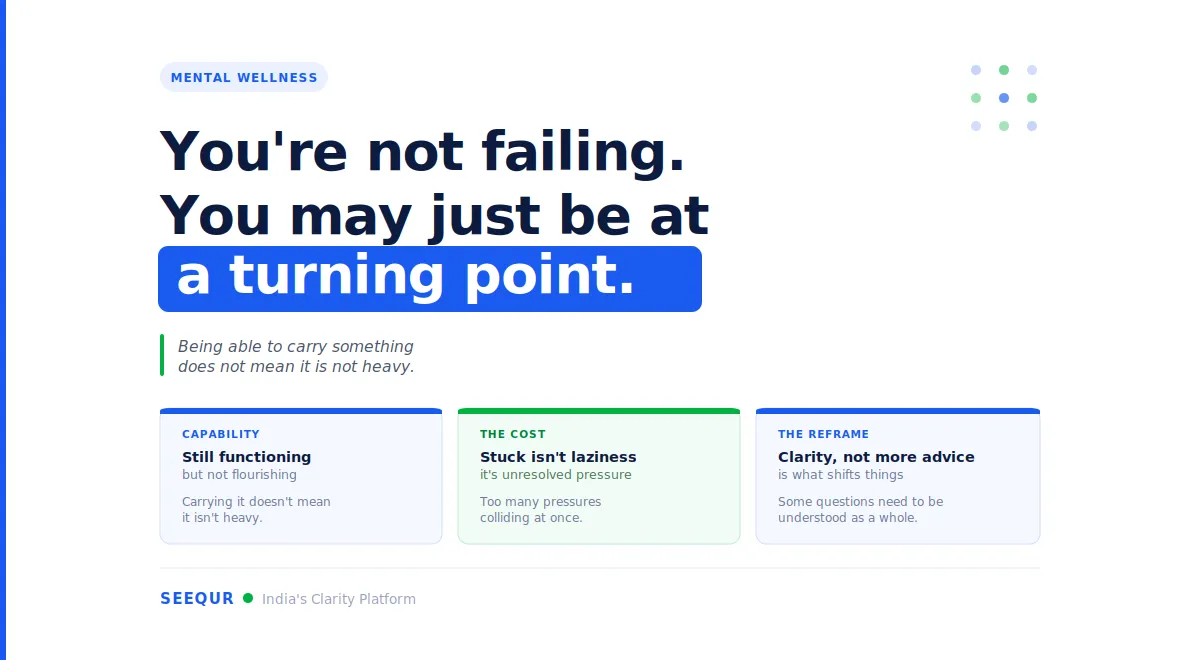
You’re Not Failing. You May Just Be at a Turning Point.
Feeling stuck doesn’t always mean you’re failing. Explore why uncertainty, pressure and unresolved questions can signal a turning point — and how clarity can help you move forward.

Official SEEQUR Editorial
Quick Summary
Feeling stuck does not always mean you are failing. This article explores how uncertainty, pressure and unresolved questions can signal a turning point, and how greater clarity can help you decide what comes next.
Key Takeaways
- Feeling stuck can be a signal that something needs attention, not proof of failure.
- Too much advice can sometimes create more confusion instead of clarity.
- Understanding what is creating pressure can make the next step easier to see.
- You do not need to have everything figured out to begin moving forward.
You may not be in crisis.
You may still be attending classes, going to work, replying to messages, helping your family, meeting deadlines, and showing up where people expect you to show up.
You may still laugh at the right moments.
You may still say, “I'm fine.”
In fact, if someone asked how you're doing, you might not even know how to explain what's wrong.
Because nothing feels completely broken.
And yet, something doesn't feel completely right either.
From the outside, your life may look normal.
But inside, there may be a sentence you keep returning to quietly:
“I don’t know what I’m doing anymore.”
Not dramatically. Not every minute. Not in a way that everyone can see.
But often enough that you know something has shifted.
You open your phone for answers and close it feeling heavier. You ask people for advice and somehow feel more confused. You save posts, watch videos, compare options, make plans, cancel them mentally, and tell yourself you just need to be more disciplined.
But what if the problem is not that you are lazy?
What if the problem is not that you are weak?
What if feeling stuck is not proof that you are failing?
What if it is a sign that some part of your life is asking for clarity?
That is the part most people do not talk about.
Many people do not ask for help when everything has fallen apart. They delay because they are still functioning. Because they are still managing. Because nothing looks “serious enough” from the outside.
And because they are still managing, they convince themselves they should not need support.
But being able to carry something does not mean it is not heavy.
Some people break under pressure.
Others become so good at carrying it that nobody notices they're struggling.
Including themselves.
The hardest kind of stuck is the kind no one can see
There is a type of stuckness that does not announce itself loudly.
It does not always look like crisis.
Sometimes it looks like scrolling late at night because silence feels uncomfortable.
Sometimes it looks like rereading the same message and not knowing how to reply.
Sometimes it looks like applying for courses, jobs, internships, or opportunities without feeling connected to any of them.
Sometimes it looks like staying in a relationship, friendship, family pattern, or career path because leaving feels too complicated and staying feels easier to explain.
Sometimes it looks like being surrounded by people but not knowing who can actually understand the real question.
This is why feeling stuck can be so lonely.
Not because nobody is around.
But because the part of you that is struggling is not always visible.
People may see your marks, job, relationship status, LinkedIn updates, family responsibilities, or daily routine. They may not see the mental tabs open in the background.
The “what if I choose wrong?” tab.
The “am I behind?” tab.
The “why does everyone else seem clearer?” tab.
The “what will people think?” tab.
The “is this really what I want?” tab.
The “why am I tired even when nothing terrible happened?” tab.
When too many of these stay open for too long, life begins to feel heavy even if nothing looks obviously wrong.
That heaviness is real.
And it deserves attention before it becomes unbearable.
Feeling stuck is not laziness. It is often unresolved pressure.
People often misunderstand stuckness as a motivation problem.
So they try to fix it with motivation.
Wake up earlier. Make a plan. Watch another video. Read another quote. Push harder. Be grateful. Stop overthinking. Just decide.
Sometimes that helps.
But often, it does not.
Because the issue is not always lack of effort. The issue may be that too many pressures are colliding at once.
You may be trying to make a career decision while also managing family expectations.
You may be trying to focus on academics while quietly worrying about whether you are even on the right path.
You may be trying to heal from a relationship while pretending it did not affect your confidence.
You may be trying to make a practical decision while carrying emotional fatigue.
You may be trying to choose what is right for you while fearing what it will cost.
That is not laziness.
That is load.
And load changes how clearly we think.
Experts often describe overwhelm as a state where the demands on a person exceed their available capacity. In that state, people can feel less able to think clearly, regulate emotions, make decisions, or move forward; it can also increase procrastination and negative self-talk.
This matters because many people blame themselves for freezing.
But freezing is not always a character flaw.
Sometimes it is the mind’s way of saying, “There is too much here to process alone.”
Why more advice sometimes makes you feel worse
We live in a time where advice is everywhere.
Google has answers.
ChatGPT has answers.
Instagram has answers.
YouTube has answers.
Friends have answers.
Parents have answers.
At first, this feels helpful. More information should mean more clarity.
But many times, it does the opposite.
The challenge is not that information is unavailable.
The challenge is that information is not the same as clarity.
Personal decisions rarely happen in a vacuum.
They happen inside real lives, real relationships, real pressures, and real consequences.
That is why even after consuming endless advice, many Seekers still feel stuck.
The problem is not that they did not search enough.
The problem is that they may need a space where their situation can be understood as a whole.
Not as a keyword.
Not as a trend.
Not as a generic problem.
As their life.
Sometimes the real question is not “What should I do?”
When people feel stuck, they often ask one big question:
“What should I do?”
It sounds practical.
But many times, it is too early.
Before “What should I do?” there are deeper questions:
What am I afraid will happen if I choose?
Whose expectation am I carrying?
What part of me already knows something needs to change?
What am I avoiding because I do not want to disappoint someone?
What would I choose if I did not have to perform certainty?
What support would make this feel less confusing?
These questions matter because stuckness is rarely only about the next step.
It is often about the meaning of the next step.
A student is not only choosing a stream, college, or exam path. They may also be choosing between family expectations, personal interest, financial pressure, and fear of falling behind.
A working professional is not only deciding whether to switch jobs. They may be asking whether they still recognise themselves in the life they built.
A person in a relationship is not only deciding whether to stay or leave. They may be confronting attachment, guilt, loneliness, self-worth, and fear of starting again.
A person feeling emotionally low is not only trying to “feel better.” They may be trying to understand why normal life has started feeling harder than it used to.
That is why simple advice can feel insulting, even when it is well meant.
Because the visible question is usually only the top layer.
The deeper question is often quieter.
And until that question is heard, no answer feels complete.
A turning point does not always feel inspiring
We often imagine turning points as dramatic moments.
A clear decision.
A bold announcement.
A fresh start.
A sudden realisation.
A before-and-after scene.
But real turning points are often less glamorous.
Sometimes a turning point feels like irritation.
You are tired of giving the same explanation.
Sometimes it feels like numbness.
You are not crying, but you are not fully present either.
Sometimes it feels like restlessness.
Nothing is technically wrong, but nothing feels settled.
Sometimes it feels like envy.
Someone else’s clarity makes you notice your own confusion.
Sometimes it feels like avoidance.
You know there is a conversation, decision, or truth waiting for you, but you keep postponing it.
Sometimes it feels like exhaustion.
Not because you did nothing, but because you have been thinking about everything.
This is important: a turning point does not always arrive as confidence.
Sometimes it arrives as discomfort.
The discomfort is not always a sign that you are on the wrong path.
It may be a sign that the old way of coping is no longer enough.
The version of you that could ignore the question may not be able to ignore it anymore.
That does not mean you need to change everything immediately.
It means you may need to stop dismissing what you already know is unresolved.
The pressure to look okay can keep people stuck longer
One of the hardest parts of being stuck is that most people feel they must justify their need for help.
They think:
“My problem is not serious enough.”
“Other people have it worse.”
“I should be able to handle this.”
“What if I sound confused?”
“What if the expert judges me?”
“What if I cannot explain it properly?”
“What if I book a session and realise I do not know what to say?”
These thoughts are common.
They are also one reason people wait too long.
This is not limited to mental health.
Many Seekers delay reaching out because they believe they should already have the answers.
Some delay seeking Academic Guidance because they feel behind.
Some delay seeking Career Guidance because they think uncertainty means failure.
Some delay discussing Relationship Support concerns because they worry they will be judged.
Some delay addressing Mental Wellness concerns because they believe they should simply "handle it."
But clarity should not be reserved for crisis.
You do not have to be falling apart to deserve a thoughtful conversation.
You do not have to have the perfect words before asking for help.
You do not have to prove that your confusion is valid.
If it is affecting how you think, decide, study, work, relate, sleep, or feel about yourself, it matters.
The 5-question clarity check
When you feel stuck, do not start by forcing yourself to solve your whole life.
Start smaller.
Ask yourself these five questions honestly:
1. What exactly feels stuck right now?
Do not answer with “everything” if you can avoid it.
Try to name the area.
Is it your career?
A relationship?
Your studies?
Your emotional state?
A family expectation?
A decision you keep avoiding?
Naming the area does not solve it, but it reduces the fog.
2. What decision or conversation am I avoiding?
Stuckness often stays alive because something remains unsaid or undecided.
Maybe you need to tell someone you are unsure.
Maybe you need to admit that a path no longer feels right.
Maybe you need to ask for support.
Maybe you need to stop pretending you are okay with something.
The avoided thing often points toward the real issue.
3. What am I afraid will happen if I move forward?
Fear hides inside indecision.
You may not be afraid of the decision itself. You may be afraid of disappointing people, wasting time, losing security, being judged, starting again, or discovering that the answer is different from what others expect.
When fear is unnamed, it controls the decision quietly.
When fear is named, it becomes something you can examine.
4. Is this one problem, or is it a mixed concern?
Many real-life problems do not fit neatly into one category.
Career confusion can affect Mental Wellness.
Academic pressure can affect family relationships.
Relationship stress can affect work and confidence.
Emotional exhaustion can make every practical decision feel harder.
This is why SEEQUR looks at life through four connected areas:
Mental Wellness, Relationship Support, Academic Guidance, and Career Guidance.
Real-life challenges rarely stay inside one category.
Academic pressure can affect Mental Wellness.
Relationship concerns can affect Career Guidance.
Career uncertainty can affect confidence, relationships, and wellbeing.
The categories may be different, but the person experiencing them is the same.
You are not confused because you are messy.
The situation may simply have more than one layer.
5. Would I benefit from thinking this through with someone trained to help?
This question is not the same as “Do I need someone to tell me what to do?”
A good Expert does not simply hand you a life decision.
They help you slow the problem down.
They help you separate facts from fear.
They help you notice patterns.
They help you ask better questions.
They help you see options that are realistic, not just ideal.
And sometimes, they help you hear what you have been trying to say to yourself for months.
When it may be time to speak to someone
It may be time to speak to a real Expert when:
You keep looping over the same issue without moving forward.
Advice from friends, family, search, or AI gives temporary relief but no lasting clarity.
You feel embarrassed to say the real concern out loud.
The decision affects your wellbeing, relationships, studies, or career.
You are tired of pretending the issue is smaller than it feels.
You need a space where you do not have to perform confidence.
You are not looking for a perfect answer, but you are ready for a clearer next step.
This is where guidance can help.
Not because you are incapable.
Not because someone else knows your life better than you.
But because being heard by the right person can change the shape of the problem.
The moment you say something clearly, it often becomes less powerful than when it stayed hidden.
Clarity usually begins when the problem is finally said out loud
A lot of people wait for clarity to arrive before they speak.
But often, clarity comes because they speak.
Because the thought becomes a sentence.
Because the sentence becomes a pattern.
Because the pattern becomes a question.
Because the question finally becomes something that can be worked with.
You may not need to change your whole life today.
You may not need a dramatic decision.
You may not need to explain everything perfectly.
Maybe the next step is simply to stop calling yourself lazy when you are actually overwhelmed.
Maybe it is to stop calling yourself weak when you are actually carrying pressure quietly.
Maybe it is to stop collecting more advice and start looking for the right kind of support.
Maybe it is to admit:
“I am not failing. I am at a point where I need clarity.”
That admission is not small.
It is often the beginning of movement.
And movement does not always start with confidence.
Sometimes it starts with honesty.
A better next step
If you are feeling stuck, you do not have to turn it into a crisis before you take it seriously.
You do not have to wait until you have the perfect words.
You do not have to know whether your concern is “big enough.”
If it matters to you, it matters.
Sometimes clarity doesn't begin with an answer.
Sometimes it begins with a conversation.
If you've been carrying a question, concern, or decision alone for longer than you should have, it may be time to stop trying to solve it in your head.
SEEQUR connects Seekers with verified Experts across Mental Wellness, Relationship Support, Academic Guidance, and Career Guidance.
Because you don't have to figure everything out alone.
The goal is not to have your entire life figured out.
The goal is simply to become a little clearer than you were yesterday.
Most meaningful change starts there.
Explore Experts on SEEQUR and take your next step with clarity.
SEEQUR publishing note
SEEQUR resources are reviewed before publishing. They are designed for clarity and education, not as a substitute for a personal session when individual guidance is needed.