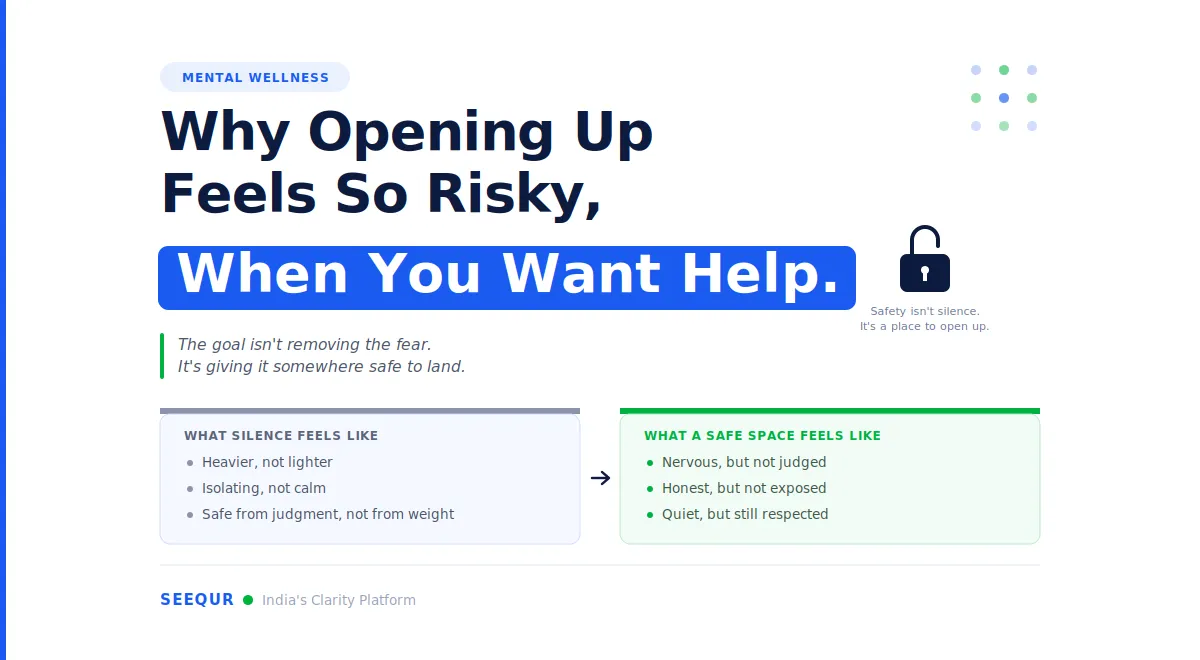
Why Opening Up Feels So Risky, Even When You Want Help
Opening up can feel risky even when you want support. Understand why judgment, misunderstanding, and vulnerability can make asking for help difficult.

Official SEEQUR Editorial
Quick Summary
Opening up is not simply about talking—it can involve fear of judgment, misunderstanding, vulnerability, and losing control of your story. The right supportive space can make it easier to speak honestly without feeling rushed or exposed.
Key Takeaways
- Fear of judgment can make opening up difficult.
- Being misunderstood can sometimes feel safer to avoid than speaking.
- Wanting privacy is different from hiding.
- You do not have to share everything with everyone.
- The right supportive space can make honest conversations easier.
Opening up sounds simple from the outside.
Just talk to someone.
Just say what is happening.
Just ask for help.
But for the person carrying the concern, it rarely feels that simple.
Because opening up is not only about speaking.
It is about risk.
The risk of being judged.
The risk of being misunderstood.
The risk of saying too much.
The risk of not being taken seriously.
The risk of someone seeing you differently after they know more.
That is why people stay quiet even when they are struggling.
Not because they have nothing to say.
Because saying it may change how they feel about themselves.
Or how someone else sees them.
And that can feel frightening.
Most people do not only fear sharing
Most people do not only fear the act of opening up.
They fear what might happen after.
Will this person think differently of me?
Will they make it bigger than it is?
Will they make it smaller than it feels?
Will they repeat it?
Will they judge me?
Will they tell me I am overthinking?
Will they give advice before they understand?
Will they see me only through this one concern?
Those questions can become heavy.
Sometimes heavy enough to keep someone silent for weeks, months, or years.
That silence is not always about secrecy.
Often, it is about protection.
People protect the parts of themselves that feel easiest to misunderstand.
The fear of judgment is not always loud
Judgment is not always a harsh sentence.
Sometimes it is a look.
A pause.
A change in tone.
A quick solution offered too soon.
A comparison to someone who “has it worse.”
A sentence that begins with:
“Why didn’t you just…”
“You should have…”
“At least…”
“But everyone goes through this…”
These responses may not always be meant to hurt.
But they can make someone close up.
Because when a person opens up, they are not only sharing facts.
They are letting someone see a part of their inner life.
If that moment is handled carelessly, the person may not try again for a long time.
That is why the fear of judgment is real.
Even when the person listening means well.
Being misunderstood can feel worse than staying silent
There is a particular kind of loneliness that comes from explaining something important and feeling misunderstood.
You finally say it.
You try to explain.
You choose your words carefully.
And the response misses the point.
They focus on the wrong detail.
They give advice for a problem you did not describe.
They tell you what they would do.
They explain why you should not feel that way.
They turn your concern into something easier for them to understand.
That can make silence feel safer.
At least silence does not distort the story.
At least silence does not turn a complicated feeling into a simple opinion.
But silence has a cost too.
What stays unspoken often becomes heavier.
Not always at once.
Sometimes slowly.
Through avoidance.
Overthinking.
Distance.
Resentment.
Confusion.
The concern may stay private, but it does not always stay small.
Privacy is not the same as hiding
Wanting privacy does not mean someone is dishonest.
It does not mean they are ashamed.
It does not mean they are unwilling to be helped.
Sometimes privacy is simply the need to choose where your story goes.
Who hears it.
How much they hear.
When they hear it.
What happens after they hear it.
That choice matters.
Especially when the concern touches Mental Wellness, Relationship Support, Academic Guidance, or Career Guidance.
These areas are personal.
They can involve family expectations, identity, self-worth, pressure, conflict, ambition, fear, confusion, or emotional weight.
People are allowed to be careful with that.
Carefulness is not weakness.
It is often wisdom.
Some things are hard to say because they affect how we see ourselves
Opening up can feel risky because the concern may not only describe what happened.
It may touch who you think you are.
A capable person may struggle to say:
“I am not coping as well as people think.”
A good student may struggle to say:
“I am scared I am falling behind.”
A responsible adult may struggle to say:
“I do not know what I am doing.”
A caring partner may struggle to say:
“I am unhappy.”
A confident person may struggle to say:
“I feel lost.”
These sentences are difficult because they challenge the version of ourselves we are used to showing others.
Sometimes the fear is not only:
“What will they think of me?”
Sometimes it is:
“What will I have to admit about myself?”
That is why opening up can feel emotional before anyone else has even heard the words.
The right space matters
Not everyone deserves the full version of your story.
That may sound harsh, but it is true.
Some people can care about you and still not know how to hold what you share.
Some people react too quickly.
Some make it about themselves.
Some become anxious.
Some try to fix everything immediately.
Some minimise.
Some dramatise.
Some mean well but leave you feeling more alone.
This does not make them bad people.
It simply means they may not be the right place for this particular conversation.
The space you choose matters because its response can shape whether you feel safer or more guarded afterward.
A good space does not force your story open.
It lets it unfold with care.
A safe conversation does not remove all fear
Even in a supportive space, opening up may still feel uncomfortable.
That is normal.
Safety does not always feel like instant ease.
Sometimes safety feels like being nervous but not judged.
Emotional but not rushed.
Unclear but not dismissed.
Honest but not exposed.
Quiet but still respected.
A good conversation does not require fear to disappear before you begin.
It simply gives the fear somewhere softer to land.
That difference matters.
Because many people wait for the moment when opening up feels easy.
Sometimes it never feels easy.
It only becomes possible.
You should not have to perform strength to deserve respect
Many people become skilled at appearing fine.
They work.
Study.
Show up.
Reply to messages.
Meet expectations.
Smile at the right times.
Keep functioning.
And because they are functioning, people assume they are fine.
Sometimes they assume it about themselves too.
But functioning is not the same as feeling clear.
Looking composed is not the same as feeling supported.
Being capable is not the same as being unaffected.
You should not have to fall apart before your concern is taken seriously.
You should not have to prove pain loudly for it to matter.
You should not have to perform strength until you no longer know how to ask for help.
Opening up is not a failure of strength.
Sometimes it is the first honest use of it.
The point is not to tell everything to everyone
Opening up does not mean sharing everything everywhere.
It does not mean becoming public with what is private.
It does not mean explaining your situation to people who have not earned your trust.
It means choosing the right space for the right conversation.
Sometimes that is a friend.
Sometimes it is family.
Sometimes it is a mentor.
Sometimes it is an Expert.
The point is not exposure.
The point is support.
The point is not to be known by everyone.
The point is to stop carrying something important entirely alone.
What becomes possible when you are not judged
When someone listens without rushing to judge, something changes.
You do not have to spend all your energy defending the concern.
You do not have to make it sound more acceptable.
You do not have to hide the uncomfortable parts.
You do not have to shrink the feeling so it does not inconvenience anyone.
You can begin to understand what is actually there.
The fear.
The pattern.
The pressure.
The decision.
The hurt.
The confusion.
The truth beneath the explanation.
Being heard clearly does not solve everything.
But it can make honesty possible.
And honesty is often where clarity begins.
Opening up is not about becoming exposed
Opening up is not about saying everything.
It is not about giving away control of your story.
It is not about letting someone else define you by one concern.
It is about choosing a space where the concern can exist without being judged, mocked, minimised, or rushed.
A space where you can say the real thing carefully.
A space where privacy is respected.
A space where your fear does not have to be hidden before it can be understood.
That is why SEEQUR exists.
SEEQUR connects Seekers with verified Experts across Mental Wellness, Relationship Support, Academic Guidance, and Career Guidance for the moments when opening up feels risky, but staying silent has become heavy.
Because the goal is not to expose your story.
The goal is to help you carry it with more clarity, care, and support.
Explore Experts on SEEQUR and take your next step with clarity.
SEEQUR publishing note
SEEQUR resources are reviewed before publishing. They are designed for clarity and education, not as a substitute for a personal session when individual guidance is needed.