How to Explain What You’re Going Through When You Don’t Have the Right Words
Struggling to explain what you’re going through? Learn how to describe patterns, fears, and concerns honestly—even when you don’t have the right words.

Official SEEQUR Editorial
Quick Summary
You don’t need the perfect words to ask for help. Learn how to describe what you’re experiencing, identify patterns and fears, and start an honest conversation even when your thoughts feel unclear.
Key Takeaways
- You don’t need perfect words to ask for help.
- Describe patterns, not just the latest incident.
- Share what you have already tried.
- Naming fears can make the real concern clearer.
- Clarity can develop through conversation.
Many people delay asking for help because they do not know how to explain what is wrong.
They can feel it.
They can think about it.
They may even talk around it for weeks.
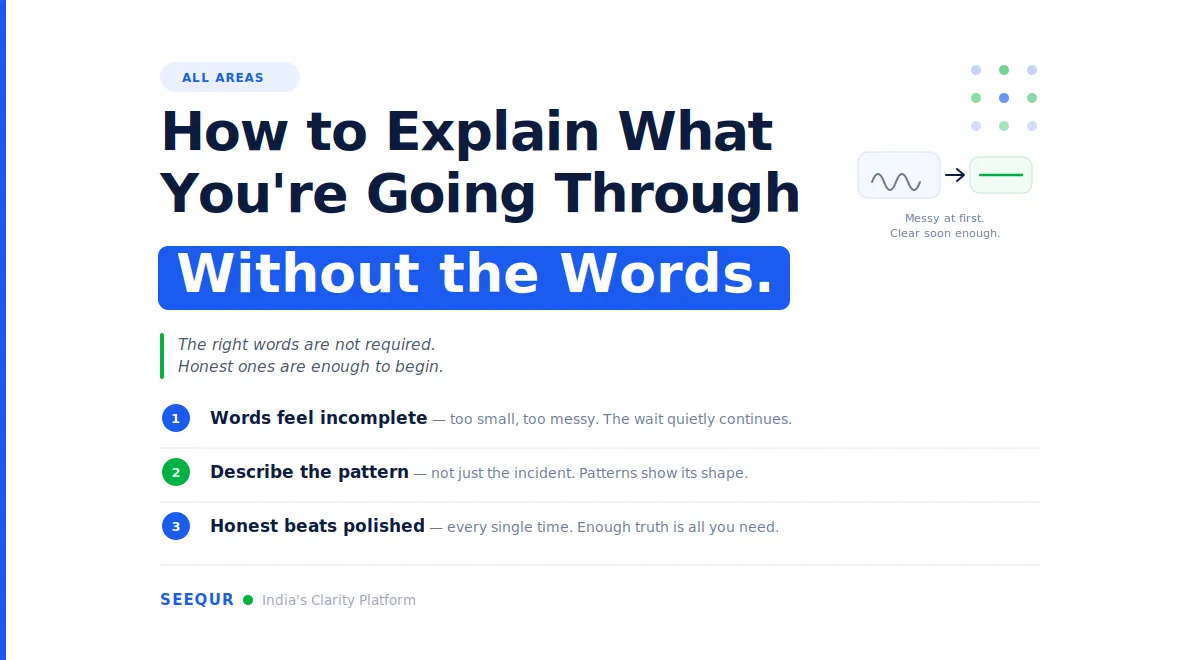
But when it comes time to say it clearly, the words feel incomplete.
Too small.
Too dramatic.
Too messy.
Too personal.
Too difficult to organise.
So they wait.
They wait until they can explain it better.
Until they understand it more clearly.
Until they can make it sound reasonable.
Until they can say it without feeling exposed.
But sometimes, the reason you need guidance is because you cannot explain it clearly yet.
That does not mean the concern is not real.
It means the concern is still finding language.
Start with what feels true, not what sounds polished
Most people try to explain their situation in a way that sounds sensible.
They edit themselves before they speak.
They remove the emotional parts.
They make the concern sound smaller.
They say the practical version because the honest version feels too vulnerable.
“I am confused about my career.”
“I am having trouble studying.”
“We are having communication issues.”
“I feel stressed.”
Those sentences may be true.
But sometimes they are only the surface.
The fuller truth may sound less polished.
“I am scared I chose this career because everyone expected it from me.”
“I sit with my books open, but I feel frozen.”
“We keep talking, but I do not feel understood.”
“I look fine, but I feel tired in a way I cannot explain.”
That kind of honesty is not dramatic.
It is useful.
A good Expert does not need you to sound composed.
They need enough truth to understand where to begin.
Describe the pattern, not only the incident
When people explain a concern, they often begin with the latest incident.
The argument.
The exam result.
The missed deadline.
The confusing conversation.
The moment they finally felt overwhelmed.
That is understandable.
The latest incident is usually the easiest thing to point to.
But often, the incident is not the whole issue.
It is part of a pattern.
A relationship concern may not be only about one argument.
It may be about the same misunderstanding happening again and again.
An academic concern may not be only about one poor result.
It may be about months of pressure, avoidance, comparison, or fear.
A career concern may not be only about one decision.
It may be about years of trying to balance interest, family expectations, money, identity, and uncertainty.
A Mental Wellness concern may not be only about one bad week.
It may be about something slowly becoming harder to carry.
Patterns help an Expert understand the shape of the concern.
So instead of asking yourself, “How do I explain everything perfectly?”
You can ask:
“What keeps happening?”
“What does this keep affecting?”
“When did I first notice this?”
“What have I been trying to ignore?”
The answer does not need to be complete.
It only needs to begin showing the pattern.
Say what you have already tried
This can be more useful than people realise.
You may have already tried to fix the concern in your own way.
You may have searched online.
Asked friends.
Spoken to family.
Made a plan.
Ignored it.
Worked harder.
Avoided the conversation.
Tried to be more disciplined.
Tried to stop caring.
Tried to convince yourself it was not serious.
Tried to wait until it passed.
These attempts matter.
Not because they failed.
Because they show what the concern has already required from you.
They also help an Expert understand what kind of support may actually be useful.
If you have already tried pushing harder, maybe the answer is not simply more pressure.
If you have already tried thinking alone, maybe the answer is not another private loop.
If you have already tried asking people close to you, maybe what you need now is a more neutral space.
What you have tried is part of the story.
It shows the effort you have already been making, even if nothing feels solved yet.
Name what feels hardest to say
There is often one part of the concern that feels harder to speak than the rest.
Not because it is complicated.
Because it is honest.
“I am afraid I do not want this anymore.”
“I feel guilty for feeling this way.”
“I do not know if I am the problem.”
“I am scared people will think I am weak.”
“I do not feel happy, even though things look fine.”
“I know what I should do, but I cannot seem to do it.”
“I do not want to disappoint my family.”
“I do not know whether to stay or leave.”
You do not have to begin with that sentence.
You do not have to force it out.
But knowing that it exists can help.
Sometimes, the most important part of the session is not the first thing you say.
It is the sentence you slowly become ready to say.
A good Expert will not rush that moment.
But they can help create the space where it becomes possible.
Include what you are afraid may happen
Fear is often part of the problem, even when the problem looks practical.
A student may not only fear poor marks.
They may fear falling behind, disappointing family, or proving something painful about themselves.
Someone facing a career decision may not only fear choosing wrongly.
They may fear wasting years, losing stability, or becoming someone they do not recognise.
Someone in a relationship may not only fear conflict.
They may fear being alone, being blamed, being misunderstood, or making an irreversible decision.
Someone carrying a Mental Wellness concern may not only fear the feeling itself.
They may fear what it means.
Fear gives context.
It explains why a concern feels heavier than it may look from the outside.
So when you speak to an Expert, it can help to say:
“This is what I am afraid may happen.”
Not because fear should decide everything.
But because fear often explains why clarity has been difficult.
Say what you want from the conversation
You do not need to know the final answer.
But it can help to name what you are hoping for.
Maybe you want clarity.
Maybe you want to understand why this keeps happening.
Maybe you want a next step.
Maybe you want to feel less alone with the concern.
Maybe you want help making sense of options.
Maybe you want to say something out loud without being judged.
Maybe you do not know what you want yet.
Even that is useful to say.
“I am not sure what I need from this conversation, but I know I do not want to keep thinking about this alone.”
That is an honest starting point.
A good Expert can work with that.
You can be unclear and still be honest
This may be the most important thing to remember.
Clarity does not always come before the conversation.
Sometimes it comes because of the conversation.
You may begin with:
“I do not know how to explain this.”
“I am not sure if this makes sense.”
“I may be mixing many things together.”
“I do not know whether this is a big issue.”
“I just know something feels difficult.”
Those sentences are not weak.
They are honest.
And honesty is more useful than performance.
You do not need the perfect explanation to deserve support.
You do not need to sound certain to be taken seriously.
You do not need to know whether your concern belongs neatly under Mental Wellness, Relationship Support, Academic Guidance, or Career Guidance.
Real concerns often overlap before they become clear.
The unclear version is often where guidance begins.
The unclear version is often where guidance begins
Sometimes people think asking for help means arriving with a fully formed problem.
But often, the first part of help is forming the problem together.
Turning a feeling into words.
Turning scattered details into a pattern.
Turning “I do not know what is wrong” into “This is what keeps happening.”
Turning “I am confused” into “This is what I am afraid of.”
Turning “I need help” into “This is the next step I can try.”
Before clarity becomes action, it often becomes language.
And language does not have to be perfect to be useful.
It only has to be honest enough to begin.
You do not have to explain it perfectly
You do not need the perfect opening sentence.
You do not need the whole story in order.
You do not need to know exactly what the problem is called.
You do not need to make your concern sound more serious than it is.
You do not need to make it sound smaller either.
You can begin with the version you have.
The incomplete version.
The messy version.
The sentence that feels closest to true.
A good Expert does not need you to arrive with the perfect explanation.
They need enough honesty to help you understand what the explanation might be.
SEEQUR connects Seekers with verified Experts across Mental Wellness, Relationship Support, Academic Guidance, and Career Guidance for the moments when a concern is real, but difficult to explain.
Because sometimes the first step is not finding the perfect words.
It is saying the real ones.
Explore Experts on SEEQUR and take your next step with clarity.
SEEQUR publishing note
SEEQUR resources are reviewed before publishing. They are designed for clarity and education, not as a substitute for a personal session when individual guidance is needed.