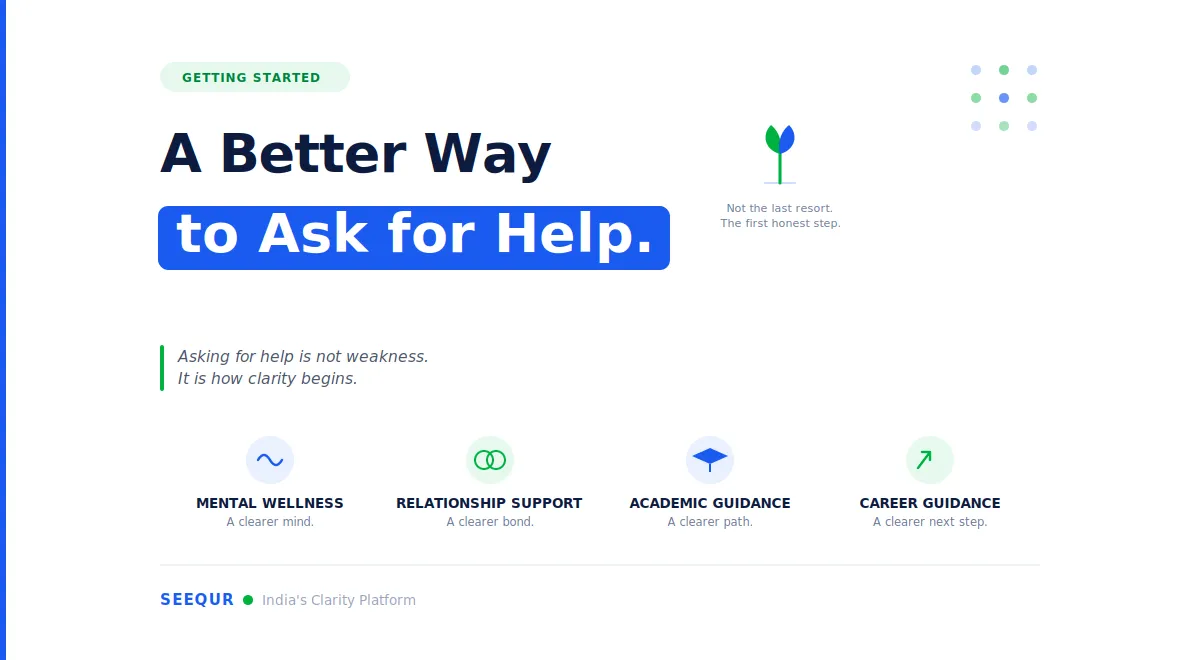
A Better Way to Ask for Help
Asking for help does not have to wait for a crisis. Discover a better way to seek guidance, find clarity, and take the next step with the right support.

Official SEEQUR Editorial
Quick Summary
People often wait until a concern becomes overwhelming before asking for help. SEEQUR offers a different approach: seek guidance earlier, understand the question more clearly, and connect with verified Experts across Mental Wellness, Relationship Support, Academic Guidance, and Career Guidance.
Key Takeaways
- Help does not have to begin only at the point of crisis.
- A better question can create a clearer path forward.
- Guidance is different from simply receiving advice.
- Asking for help does not mean giving up control.
- The right Expert can help bring context and clarity to the next step.
Asking for help is often treated like a last step.
Something people do after they have tried everything else.
After the searching.
After the overthinking.
After the private attempts.
After the advice from friends.
After the pressure has built.
After things have become difficult enough to justify speaking.
Many people wait until the concern feels serious enough.
Clear enough.
Urgent enough.
Easy enough to explain.
Acceptable enough to share.
But help does not have to begin only at the point of crisis.
It can begin earlier.
When the question keeps returning.
When the confusion is becoming heavy.
When advice is no longer creating clarity.
When the next step matters, but does not feel clear.
When someone is not falling apart, but still knows they should not have to carry the question alone.
That is the space SEEQUR was built for.
Not only the moment when everything breaks.
The moment before the next step.
People often wait too long to ask
Most people do not delay asking for help because they are careless.
They delay because asking can feel complicated.
It can feel like admitting weakness.
It can feel like making the problem real.
It can feel like inviting judgment.
It can feel like burdening someone else.
It can feel like losing control of the story.
So they manage privately.
They search.
They compare.
They think.
They distract themselves.
They try harder.
They tell themselves it is not serious.
They wait for the perfect explanation before speaking.
But sometimes, the longer someone waits for the perfect way to ask, the heavier the concern becomes.
The problem is not that people do not want help.
The problem is that many people have learned to ask only when they have already reached their limit.
There should be a better way.
Help should not have to wait for crisis
Some concerns need urgent care.
Some situations require immediate support.
But not every meaningful concern begins as a crisis.
Some begin as uncertainty.
A career question that keeps returning.
A relationship pattern that is becoming harder to ignore.
An academic pressure that slowly begins to affect confidence.
A Mental Wellness concern that does not look dramatic from the outside, but quietly changes how someone feels inside.
These moments matter too.
They are often the moments when guidance can help before the concern becomes heavier.
Before confusion becomes avoidance.
Before pressure becomes exhaustion.
Before silence becomes distance.
Before a question becomes something someone carries alone for too long.
Asking for help earlier is not overreacting.
It is not weakness.
It is often the most responsible moment to begin.
The right question can change the next step
People often think help means receiving an answer.
Sometimes it does.
But often, real guidance begins by finding the better question.
A Seeker may arrive asking:
“What career should I choose?”
But the deeper question may be:
“What kind of life am I trying to build, and what am I afraid to disappoint?”
Someone may ask:
“How do I fix this relationship?”
But the deeper question may be:
“What pattern keeps repeating, and what have I stopped saying honestly?”
A student may ask:
“How do I become more disciplined?”
But the deeper question may be:
“What is making focus feel so difficult right now?”
Someone may ask:
“Why do I feel this way?”
But the deeper question may be:
“What have I been carrying without naming?”
The first question is not wrong.
It is simply the doorway.
A good Expert helps a Seeker understand what the question is really asking.
That can change the direction of the next step.
Because a better question often creates a better path forward.
Guidance is different from advice
Advice often arrives quickly.
It tells.
Suggests.
Solves.
Compares.
Reassures.
Sometimes advice is helpful.
Sometimes it is exactly what someone needs.
But many personal concerns are not only asking for advice.
They are asking for understanding.
Guidance is slower.
It listens before it answers.
It considers context.
It notices patterns.
It asks what has already been tried.
It understands that the same concern may affect Mental Wellness, Relationship Support, Academic Guidance, and Career Guidance at the same time.
It does not reduce a person to one problem.
It helps them see the situation more clearly.
That difference matters.
Because people do not always need louder advice.
Sometimes they need a clearer conversation.
A better way to ask for help needs more than a list of names
When someone is carrying a personal question, they usually need more than names to browse.
They need a place to begin.
A way to understand what kind of support may fit.
A way to move from thinking alone to speaking with someone who can help them understand.
That is why SEEQUR is built around real areas of life, not just search.
Mental Wellness.
Relationship Support.
Academic Guidance.
Career Guidance.
Real life does not always keep these concerns separate.
Career confusion can affect confidence.
Academic pressure can affect emotional wellbeing.
Relationship concerns can affect focus, sleep, and self-worth.
Mental Wellness can influence how someone studies, works, chooses, and connects.
A better way to ask for help has to respect those connections.
It has to give Seekers a place to begin, even when the concern is not perfectly labelled yet.
Asking for help is not giving up control
One reason people hesitate is because they fear that asking for help means handing over their life to someone else.
But good guidance does not take control away.
It helps a person understand their own choices more clearly.
An Expert may ask questions.
Offer perspective.
Help organise thoughts.
Notice patterns.
Challenge assumptions gently.
Support the next step.
But the Seeker’s life remains the Seeker’s life.
The decision remains theirs.
The pace remains theirs.
The story remains theirs.
Asking for help is not surrendering responsibility.
It is choosing not to carry the responsibility without support.
That is a very different thing.
The better way is human, careful, and clear
A better way to ask for help does not shame people for searching first.
It does not tell them they should have asked earlier.
It does not make every concern sound like a crisis.
It does not promise instant answers.
It does not pretend one conversation solves everything.
A better way respects the hesitation.
It understands why people wait.
It gives them room to begin imperfectly.
It recognises that privacy matters.
It allows confusion to arrive before clarity.
It makes support feel less like a last resort and more like a thoughtful next step.
That is the kind of help SEEQUR believes in.
Help that is human.
Careful.
Clear.
Grounded.
Respectful of the person and the problem.
Clarity begins when the question is no longer carried alone
A question can stay inside someone’s head for a long time.
It can become familiar there.
It can repeat itself quietly.
In the morning.
At work.
During study.
After a conversation.
Before sleep.
It can sound different each time, but carry the same weight.
At some point, the question may not need another private loop.
It may need a place to be spoken.
Not shouted.
Not judged.
Not rushed.
Spoken.
A space where it can be heard clearly.
A space where it can be understood with context.
A space where it can become less tangled.
That is often where clarity begins.
Not when someone has the perfect words.
Not when the problem is fully solved.
Not when fear disappears completely.
But when the question is no longer carried alone.
A better way to ask for help is a better way to begin
SEEQUR exists because people should not have to wait until they are overwhelmed to seek guidance.
They should not have to reduce complex concerns into simple labels.
They should not have to choose between private overthinking and public vulnerability.
They should not have to search endlessly when what they need is a real conversation.
They should have a way to ask earlier.
More clearly.
More safely.
More honestly.
With access to verified Experts across Mental Wellness, Relationship Support, Academic Guidance, and Career Guidance.
Because asking for help is not weakness.
It is how clarity begins.
And clarity can change the direction of someone’s next step.
Explore SEEQUR — a better way to ask for help.
SEEQUR publishing note
SEEQUR resources are reviewed before publishing. They are designed for clarity and education, not as a substitute for a personal session when individual guidance is needed.