Why Smart, Capable People Delay Asking for Help
Capable people often delay asking for help because they are used to handling things alone. Explore why strength, overthinking and self-reliance can sometimes delay clarity.

Official SEEQUR Editorial
Quick Summary
Smart, capable people can be especially likely to delay asking for help because they are accustomed to solving problems independently. Self-reliance, overthinking and the ability to keep functioning can make unresolved concerns easier to postpone. Seeking perspective does not have to be a last resort; sometimes conversation is where clarity begins.
Key Takeaways
- Capable people can become so accustomed to coping alone that asking for support feels unfamiliar.
- Being able to function does not necessarily mean everything is okay.
- Overthinking and seeing too many sides of a problem can delay action.
- Unresolved concerns can gradually begin affecting other areas of life.
- Asking for perspective can be a responsible step toward greater clarity.
The people who ask for help first are not always the people who need it most.
Sometimes the people who need help most are the ones everyone else depends on.
The responsible one.
The reliable one.
The capable one.
The one who usually figures things out.
The one who solves problems.
The one who gives advice.
The one who says, "Don't worry, it'll work out."
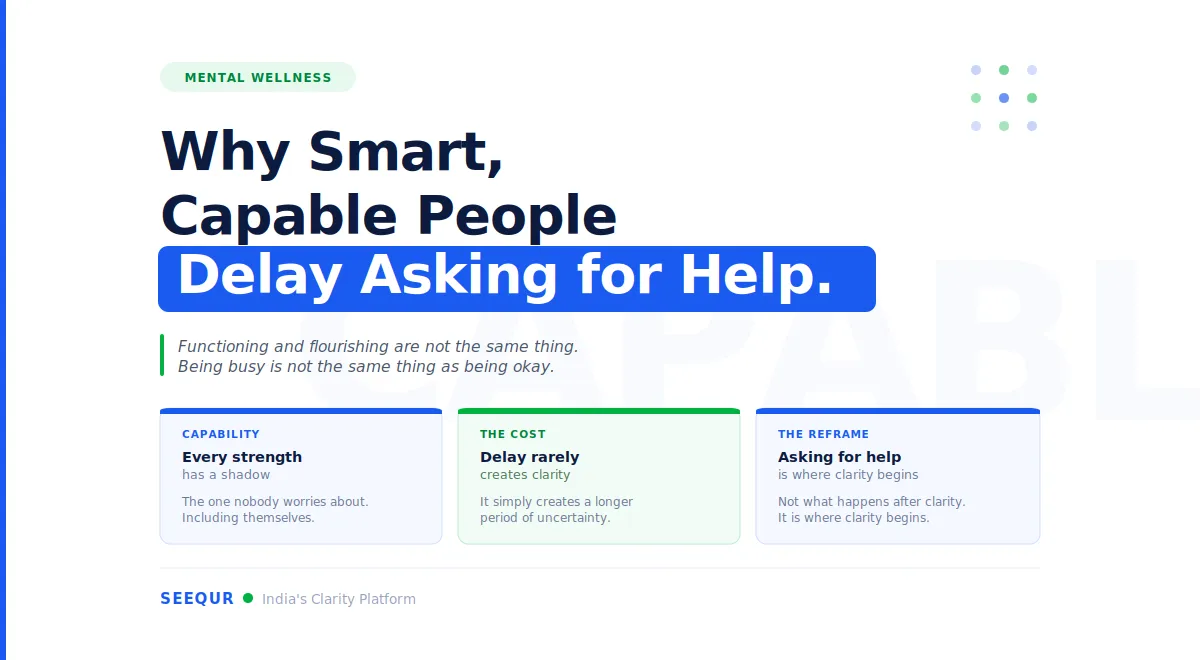
The one nobody worries about.
Including themselves.
From the outside, these people often seem fine.
They are functioning.
Working.
Studying.
Showing up.
Meeting responsibilities.
Keeping promises.
Managing expectations.
And because they are still functioning, nobody asks if they are struggling.
Sometimes they don't ask themselves either.
This is one of the least talked about reasons people delay asking for help.
Not because they are weak.
Not because they are careless.
Not because they do not care.
But because they have become so used to carrying things alone that asking for support feels unfamiliar.
Sometimes even uncomfortable.
The Hidden Burden of Being Capable
Being capable is usually seen as a strength.
And often it is.
Capable people are trusted.
They are dependable.
They are resilient.
They get things done.
But every strength has a shadow.
The more capable someone appears, the more likely people are to assume they are okay.
Over time, something subtle happens.
The capable person starts making the same assumption.
"I'll figure it out."
"I just need more time."
"I've handled worse."
"It's not a big deal."
"I don't need help."
At first, these thoughts can be useful.
They help people stay calm.
Stay focused.
Stay moving.
But eventually, what begins as confidence can become isolation.
Not because nobody cares.
Because nobody realizes support is needed.
Including the person carrying the burden.
Why Smart People Often Wait Longer Than They Should
Most people assume that if a problem is important, they will deal with it.
But that is not always how life works.
Many intelligent, self-aware people delay addressing important concerns for surprisingly long periods of time.
Not because they cannot see the issue.
Because they can see too many sides of it.
They understand the complexity.
They understand the consequences.
They understand the trade-offs.
And sometimes that understanding makes action harder, not easier.
Instead of making a decision, they keep gathering information.
Instead of having a conversation, they keep thinking about having one.
Instead of seeking guidance, they keep trying to solve the problem privately.
The delay often feels reasonable.
Productive, even.
But there is a difference between thinking something through and staying trapped inside the same loop.
The longer the loop continues, the harder it becomes to tell the difference.
The Things People Tell Themselves
Most delays do not sound dramatic.
They sound sensible.
That is why they are so effective.
People tell themselves:
"It's not serious enough."
"Let me think about it a little longer."
"I should be able to handle this."
"Other people have bigger problems."
"I don't even know how to explain it."
"What if I talk to someone and still don't know what to do?"
"What if the Expert confirms what I'm afraid is true?"
That last one is more common than many people realize.
Because clarity can be uncomfortable.
Sometimes uncertainty feels safer than an answer.
An answer may require a decision.
A conversation.
A change.
Responsibility.
And so people delay.
Not because they want confusion.
Because confusion sometimes feels easier than action.
At least for a while.
The Danger of Becoming the Person Who Always Copes
Some people break under pressure.
Others become experts at functioning under pressure.
The second group often goes unnoticed much longer.
Including by themselves.
They keep working.
Keep studying.
Keep showing up.
Keep performing.
And because life continues moving, they assume everything is under control.
But functioning and flourishing are not the same thing.
Being productive is not the same thing as being clear.
Being busy is not the same thing as being okay.
Many people become so focused on keeping life moving that they never stop to ask whether it is moving in the right direction.
That is where delay starts costing them.
Not because something dramatic happens.
Because months pass.
Then years.
And the same question remains unanswered.
Delay Feels Safe Until It Starts Costing You
Very few people wake up one morning and decide to ignore an important issue.
Delay usually happens gradually.
A postponed conversation.
A postponed decision.
A postponed concern.
A postponed next step.
One week becomes one month.
One month becomes six.
And eventually, the problem begins affecting more areas of life.
A Career Guidance concern starts affecting confidence.
Academic uncertainty starts affecting Mental Wellness.
Relationship concerns start affecting focus and energy.
Emotional exhaustion starts affecting decision-making.
The challenge is rarely the original issue alone.
The challenge is the cost of carrying it unresolved.
Delay rarely creates clarity.
Most of the time, it simply creates a longer period of uncertainty.
What Asking for Help Actually Means
Many people treat asking for help as a last resort.
Something you do when you have run out of options.
When things become serious.
When everything else has failed.
But that view misses something important.
Asking for help is not necessarily a sign that you cannot solve a problem.
Sometimes it is a sign that you care enough to solve it properly.
Sometimes it is a sign that you are willing to look at the situation honestly.
Sometimes it is a sign that you recognize perspective has limits.
Even your own.
The strongest people are not always the people who carry everything alone.
Sometimes they are the people willing to say:
"I do not think I should keep carrying this by myself."
That is not weakness.
It is responsibility.
Clarity Rarely Arrives Before the Conversation
One of the biggest misconceptions about guidance is that people need to know exactly what to say before they reach out.
They think:
"I'll talk to someone once I can explain it properly."
But clarity does not always arrive before the conversation.
Very often, clarity arrives because of the conversation.
The conversation helps people discover what they are actually trying to say.
What they are actually worried about.
What they are actually avoiding.
What they actually want.
This is true across Mental Wellness, Relationship Support, Academic Guidance, and Career Guidance.
People do not always seek guidance because they need answers.
Sometimes they seek guidance because they need help understanding the question.
The Most Capable Thing You Can Do
You do not get extra credit for carrying confusion alone.
You do not become stronger by delaying clarity.
And you do not have to wait until something becomes a crisis before a conversation becomes worthwhile.
If a concern keeps returning.
If a decision keeps circling in your mind.
If a question refuses to go away.
That is often information.
Not weakness.
Sometimes the most capable thing a person can do is admit they do not have to figure everything out alone.
Not every concern needs an immediate answer.
But some concerns deserve a conversation.
Especially the ones that keep returning, even when you try to move on.
SEEQUR connects Seekers with verified Experts across Mental Wellness, Relationship Support, Academic Guidance, and Career Guidance.
Because asking for help is not what happens after clarity.
Very often, it is where clarity begins.
Explore Experts on SEEQUR and take your next step with clarity.
SEEQUR publishing note
SEEQUR resources are reviewed before publishing. They are designed for clarity and education, not as a substitute for a personal session when individual guidance is needed.