Expats - Visas - Migrants....CULTURAL TRAUMA!
When You Belong Everywhere and Nowhere: The Psychology of Living Between Two Cultures!

Sometimes, the hardest part of moving to a new world is discovering that the old one no longer feels quite like home.
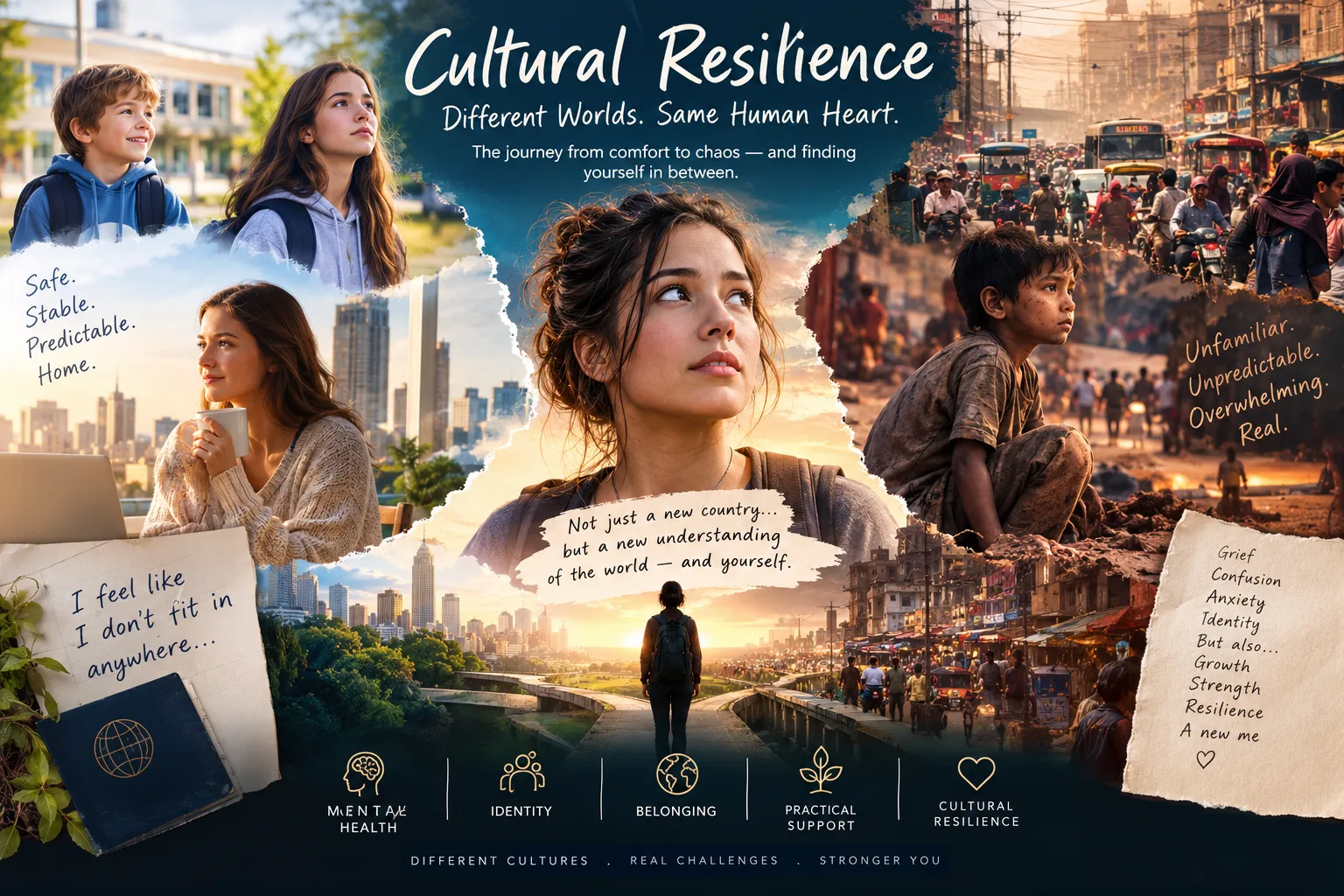
Imagine growing up in a place where safety, independence, and predictability are part of everyday life. You build your identity around familiar routines, friendships, and the belief that the world operates in a certain way.
Then life takes you somewhere completely different.
The streets are louder, social expectations change, inequality becomes more visible, and situations you once considered extraordinary become part of your daily routine.
Suddenly, you are not just adjusting to a new country. You are questioning everything you thought you knew about people, society, and yourself.
This is the often-overlooked psychology of living between two worlds.
When your mind struggles to catch up
Moving across cultures is usually described as an adventure. We talk about food, language, travel, and new opportunities. But what happens when your mind struggles to make sense of your surroundings?
An unfamiliar environment can demand constant attention. You may become more alert, easily frustrated, emotionally exhausted, or disconnected from situations that once affected you deeply.
For children, this can mean losing their sense of safety. For teenagers, it can mean struggling with identity and belonging. For adults, it can challenge long-held beliefs about fairness, independence, and how society should function.
Imagine a teenager who once walked freely around their neighbourhood but now feels restricted. Or an adult who witnesses children working on the streets and struggles to reconcile that reality with everything they previously understood about childhood.
These experiences can create sadness, guilt, anger, and helplessness.
They do not automatically constitute psychological trauma, but they can place a real emotional burden on a person.
Sometimes, the mind does not need to experience direct harm to feel overwhelmed. It simply needs time to understand a world that no longer feels predictable.
The identity crisis: Where do I belong?
One of the most difficult questions people face during cultural transitions is deceptively simple:
Who am I when the world that shaped me is no longer the world I live in?
You may appreciate your upbringing while questioning some of its assumptions. You may admire your new culture while struggling with certain social norms. You might feel like an outsider in your new home and, unexpectedly, feel different when you return to the place you once called home.
For young people, this can become particularly complicated. They may feel too Western for their new surroundings and too different to fit comfortably back into their old lives.
Adults experience their own version of this conflict. Professional identity, personal values, family expectations, and familiar social structures can all change meaning when viewed through a different cultural lens.
The result is not always a loss of identity. Sometimes, it is an identity that has outgrown its original boundaries.
We often rush to label ourselves because uncertainty feels uncomfortable. Yet personal growth does not always arrive with a clear definition of who we are.
Sometimes, the healthiest response is to accept that we are still becoming.
When empathy becomes exhausting
Living in a different society can expose us to realities we have never had to confront personally. Poverty, inequality, unsafe environments, and limited access to opportunity may become difficult to ignore.
Initially, we may feel deeply affected. Over time, however, repeated exposure can change our emotional responses.
We may become less reactive, begin looking away, or tell ourselves that difficult circumstances are simply part of life.
But is this resilience, or are we becoming emotionally detached?
The answer depends on the person and the circumstances. Emotional adaptation can help us function, but prolonged distress can also lead to exhaustion or disengagement.
Resilience should not mean becoming indifferent to suffering. Nor should compassion require us to carry every problem we witness.
We can care deeply without believing we must solve everything. We can take meaningful action while recognising our limits.
Empathy needs boundaries, just as resilience needs compassion.
Cultural resilience is not about surrendering your values
There is a difference between adapting to a culture and accepting everything within it.
Cultural resilience means learning to understand unfamiliar perspectives without immediately judging them through the standards of our own upbringing. It means recognising that people are shaped by their circumstances, opportunities, relationships, and social environments.
A delayed meeting, for example, might initially appear disrespectful. Yet circumstances you do not know about may explain the delay. Understanding those circumstances does not mean abandoning punctuality; it means making a more informed judgement.
The same principle applies to communication, family relationships, independence, and social expectations.
Cultural humility asks us to consider three questions:
- What am I assuming without fully understanding?
- What can I learn from this experience?
- What genuinely conflicts with my values, safety, or boundaries?
We can appreciate a culture's generosity and warmth while challenging inequality or unsafe conditions. We can learn from unfamiliar traditions without romanticising hardship.
Adaptation should expand our understanding, not erase our principles.
Five ways to navigate life between two worlds
Cultural adjustment takes time, and there is no universal timeline for feeling at home. A few practical steps can make the transition more manageable.
1. Preserve what grounds you. Maintain familiar routines, friendships, family traditions, and activities that give you a sense of continuity.
2. Make space for difficult emotions. Homesickness, frustration, grief, and confusion are not signs of failure. Talk about them instead of forcing yourself to appear comfortable.
3. Build genuine relationships. Learn from local people, participate in community life, and maintain connections with those who understand your background. Belonging often grows through relationships, not observation alone.
4. Protect your emotional energy. You do not need to absorb every distressing experience to prove that you care. Set boundaries, rest, and seek support when emotional strain begins affecting everyday life.
5. Allow your identity to evolve. You can retain your values, accent, humour, and traditions while developing new perspectives. You do not have to choose one culture at the expense of another.
If anxiety, persistent low mood, sleep difficulties, withdrawal, or other symptoms begin interfering with daily functioning, professional mental health support may help. Asking for help is not a failure to adapt; it is part of adapting well.
Becoming someone new without rejecting who you were
Perhaps the most meaningful lesson of cultural resilience is that no single environment prepares us for every reality.
A predictable upbringing can teach trust, planning, and independence. A less predictable environment may demand flexibility, improvisation, and resourcefulness. These are broad possibilities, not fixed characteristics of entire cultures, and every society contains enormous diversity.
The opportunity lies in learning from different experiences without ranking people's worth.
You may discover that some beliefs you once held no longer serve you. You may become more aware of your privileges, more sensitive to inequality, or more willing to question your assumptions.
You may also decide that certain environments are not right for your wellbeing. Growth does not require you to remain somewhere that causes harm.
And you do not have to turn every difficult experience into a lesson. Sometimes, it is simply difficult, and you deserve support while navigating it.
A final reflection
What if belonging is not about finding a place where everything feels familiar?
What if it is about developing the confidence to remain yourself while learning to understand people whose experiences differ from your own?
You can appreciate your past without being imprisoned by it. You can embrace a new culture without abandoning your boundaries. You can acknowledge suffering without allowing it to consume you.
And you can change without treating the person you once were as a mistake.
You do not have to belong perfectly to move forward meaningfully. Sometimes, growth begins when you give yourself permission to live in the in-between.
About the Author
Dr. Sameer Adtani | Cultural Resilience Specialist & Behavioural Scientist
Dr. Sameer Adtani works across behavioural sciences, mental wellness, emotional wellbeing, and crisis support. Drawing on CBT-based and Solution-Focused Brief Therapy approaches, his work explores how culture, human behaviour, and life transitions influence identity, relationships, and emotional resilience.
Because understanding people begins with understanding the worlds they have lived in.
Additional links
Work with Dr Sameer Adtani
This article was written by a verified SEEQUR Expert. You can book a personal session with them.
SEEQUR publishing note
SEEQUR resources are reviewed before publishing. They are designed for clarity and education, not as a substitute for a personal session when individual guidance is needed.