The Questions Google, ChatGPT, and Friends Can’t Answer for You
Google, AI tools, friends and family can all help. But some questions need context, interpretation and a real conversation before they become clear

Official SEEQUR Editorial
Quick Summary
Search engines, AI, friends and family can provide useful information and advice, but personal decisions often need context. This article explains the difference between collecting answers and getting guidance that helps you understand what matters in your own situation.
Key Takeaways
- Information can help you understand a problem without necessarily helping you decide what it means for you.
- Search and AI work best when the question itself is already clear.
- Friends and family can care deeply while still seeing situations through their own experiences.
- Guidance is different from advice because it begins with your context.
- Some questions keep returning because they need conversation, not more information.
It makes sense to search first.
Most of us do.
When something feels confusing, heavy, awkward, or too personal to say out loud, searching can feel safer than speaking.
You can type a question without explaining your whole life.
You can ask an AI tool without worrying that it will judge you.
You can message a friend and hope they understand what you mean.
You can listen to family because they know parts of your story no one else does.
These are not wrong places to begin.
Sometimes they help.
A search result can give language to what you are feeling.
An AI tool can help organise thoughts that felt scattered.
A friend can make you feel less alone.
A family member can offer care, experience, and concern.
But sometimes, even after all of that, the question remains.
You have searched.
You have read.
You have asked.
You have listened.
You may even understand the issue better than before.
And still, you do not feel clear.
That is usually not because you failed to find enough answers.
It may be because the question was never asking only for information.
Some questions need context.
Some need interpretation.
Some need emotional honesty.
Some need a trained, neutral person to help you understand what is actually happening beneath the surface.
That is the difference between advice and guidance.
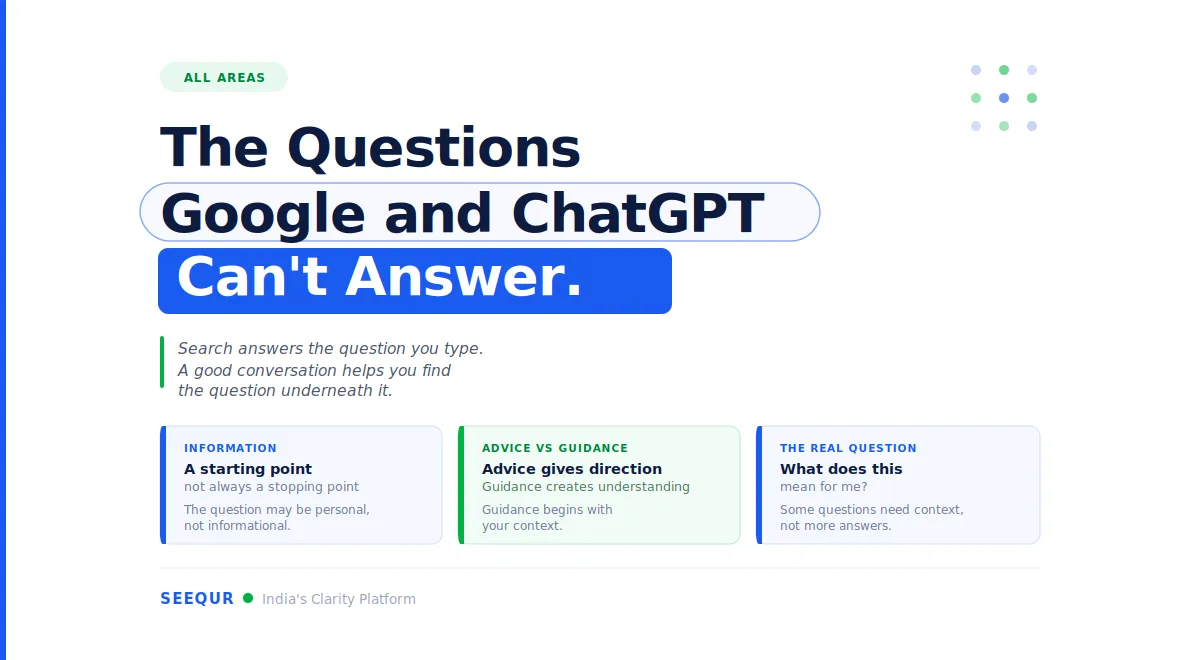
Information is a starting point, not always a stopping point
Information is useful.
It can help you understand terms, compare options, learn about possibilities, and feel less lost.
If you want to know what a career path involves, search can help.
If you want to understand common signs of stress, credible resources can help.
If you want to organise pros and cons, an AI tool can help.
If you want reassurance, a friend can help.
The problem begins when a question keeps returning even after you have gathered information.
That is often a sign that the issue is not only informational.
It is personal.
For example:
A Seeker may search career options for weeks and still feel stuck because the real question is not, “Which career pays well?”
It may be, “Which path can I choose without losing myself or disappointing everyone else?”
A student may watch productivity videos and still struggle to focus because the real issue is not time management alone.
It may be fear, pressure, sleep, confidence, or Mental Wellness.
Someone in a relationship may ask friends what to do and receive caring advice, but still feel unsettled because the question is not simply, “Should I stay or leave?”
It may be, “What pattern am I repeating, and what am I afraid will happen if I choose differently?”
Information can show you possible answers.
Guidance helps you understand which question you are really asking.
Search answers what you type
Search is powerful when the question is clear.
“What are career options after commerce?”
“How do I prepare for an interview?”
“What is burnout?”
“How do I manage exam stress?”
These are searchable questions.
And searching them can be helpful.
But many life questions begin before we have the right words.
They begin as discomfort.
A loop.
A hesitation.
A feeling that something is off.
You may type:
“Why am I confused about my career?”
But the real question may be:
“Am I choosing this because I want it, or because I am afraid of disappointing people?”
You may type:
“Why can’t I focus?”
But the real question may be:
“What pressure am I carrying that I have not named?”
You may type:
“How do I move on?”
But the real question may be:
“Why does this relationship still have such a hold on me?”
Search can answer the question you type.
A good conversation can help uncover the question underneath it.
AI can organise thoughts, but it cannot know what you have not said
AI tools can be genuinely useful.
They can summarise.
Compare.
Draft.
Structure.
Suggest.
Reflect.
For many people, they feel like a private first step when a question feels too sensitive to share.
That can be valuable.
But AI works with what you give it.
If you leave out part of the story, it may not know what matters.
If you describe the situation in a way that protects you from the harder truth, it may follow that framing.
If you ask for reassurance when you actually need challenge, it may sound comforting but not necessarily clarifying.
If you ask for a decision without sharing the emotional, family, academic, relationship, or career context around it, the answer may be neat but incomplete.
This does not make AI useless.
It means AI is better at organising information than carrying responsibility with you.
For some questions, that is enough.
For others, especially when they involve your mental wellness, relationships, academics, or career., you may need more than a well-structured answer.
You may need a real conversation.
Friends can care deeply and still see through their own lens
Friends can be one of the most important forms of support.
They know your tone.
They know your patterns.
They may notice when you are not yourself.
They may say the one sentence that helps you breathe again.
That matters.
But friends are also human.
They may advise you based on what they would do.
They may protect you because they care.
They may avoid saying something difficult because they do not want to hurt you.
They may dislike someone involved and find it hard to be neutral.
They may want you to choose quickly because they are tired of seeing you struggle.
None of this means their support is wrong.
It simply means friendship and guidance are not the same thing.
A friend can stand beside you.
A good Expert can help you examine the situation more fully.
Both can matter.
They just play different roles.
Family advice often carries love and expectation together
Family advice can come from deep care.
It can also come from fear.
Fear that you will struggle.
Fear that you will make the wrong choice.
Fear that your life will become harder than theirs had to be.
In many families, especially around Academic Guidance and Career Guidance, advice is rarely just advice.
It may carry sacrifice.
Social expectations.
Financial realities.
Past experiences.
Status.
Safety.
Protection.
Sometimes that advice is wise.
Sometimes it is incomplete.
Often, it is both.
A family member may genuinely want the best for you and still struggle to separate your life from their hopes.
That is why family advice can feel confusing.
You may respect it.
You may understand it.
You may even agree with parts of it.
And still feel unsure whether it is fully yours.
Guidance does not mean rejecting family advice.
It means understanding where that advice fits in the larger picture of your life.
Guidance is different from advice
Advice often gives direction.
Guidance creates understanding.
Advice may say:
“Choose this.”
Guidance asks:
“What makes this choice difficult?”
Advice may be quick.
Guidance is careful.
Advice may come from someone else’s experience.
Guidance begins with your context.
Advice can be useful when the problem is simple.
Guidance becomes important when the problem is layered.
A good Expert does not simply tell a Seeker what to do.
They help the Seeker think more clearly.
They ask better questions.
They notice patterns.
They help separate facts from fear.
They help identify what is urgent, what is important, and what is being avoided.
They do not take responsibility away from the Seeker.
They support the Seeker in carrying it more clearly.
That is a very different kind of help.
When more answers are not creating clarity
You may not need to stop searching.
You may not need to stop using AI.
You may not need to stop asking people you trust.
But there comes a point when the same question keeps returning, no matter how many answers you collect.
You understand the options, yet still feel uncertain.
You have advice, yet still feel unsettled.
You keep rephrasing the same concern, hoping the next article, video, search result, conversation, or tool will finally make everything click.
Sometimes the issue is not that you need another answer.
Sometimes the issue is that you need help understanding what matters most in your specific situation.
This is especially true when the question touches your Mental Wellness, Relationship Support, Academic Guidance, or Career Guidance.
Not because those areas are unusually complicated.
Because they are deeply personal.
And personal decisions rarely become clear through information alone.
They become clearer when someone helps you think through them honestly.
The question may be asking for more than information
Not every question needs an Expert.
Some questions really can be answered by a search result, a tool, a friend, or a family conversation.
But some questions keep returning because they are not only asking:
“What should I know?”
They are asking:
“What does this mean for me?”
“What am I not seeing?”
“What am I afraid to admit?”
“What choice can I live with?”
“What is the next step that is honest and realistic?”
Those questions need more than content.
They need context.
They need care.
They need a space where you can think out loud without performing certainty.
SEEQUR connects Seekers with verified Experts across Mental Wellness, Relationship Support, Academic Guidance, and Career Guidance when a question needs more than another answer.
Because the goal is not to collect more advice.
The goal is to find clarity.
Explore Experts on SEEQUR and take your next step with clarity.
SEEQUR publishing note
SEEQUR resources are reviewed before publishing. They are designed for clarity and education, not as a substitute for a personal session when individual guidance is needed.